

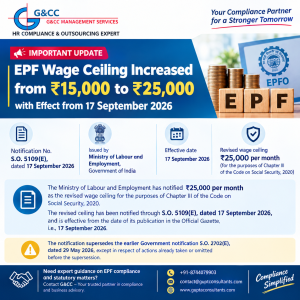
EPF Wage Ceiling Increased from ₹15,000 to ₹25,000 with Effect from 17 September 2026
Notification No.: S.O. 5109(E), dated 17 September 2026
Issued by: Ministry of Labour and Employment, Government of India
Effective date: 17 September 2026
The Ministry of Labour and Employment has notified ₹25,000 per month as the revised wage ceiling for the purposes of Chapter III of the Code on Social Security, 2020.
The revised ceiling has been notified through S.O. 5109(E), dated 17 September 2026, and is effective from the date of its publication in the Official Gazette, i.e., 17 September 2026.
The notification supersedes the earlier Government notification S.O. 2702(E), dated 29 May 2026, except in respect of actions already taken or omitted before the supersession.
What Has Changed?
The statutory wage ceiling has been enhanced as follows:
|
Particulars |
Earlier ceiling |
Revised ceiling |
|
Monthly wage ceiling |
₹15,000 |
₹25,000 |
|
Effective date |
— |
17 September 2026 |
This revision will materially expand the number of employees falling within mandatory provident fund and associated social-security coverage, subject to the applicable scheme provisions and further operational instructions issued by the EPFO.
Employees Drawing Between ₹15,001 and ₹25,000
Employees who were earlier treated as excluded employees only because their wages exceeded ₹15,000, but whose statutory wages are now ₹25,000 or below, will ordinarily come within mandatory coverage from the effective date.
Employers should immediately:
- Identify employees drawing statutory wages between ₹15,001 and ₹25,000;
- Verify whether they have any previous EPF membership or an existing UAN;
- Enrol eligible employees under the EPF framework;
- Complete UAN linking, KYC and nomination requirements;
- Deduct and deposit the applicable employee and employer contributions; and
- Include the employees in the applicable ECR filing.
The previous classification of such employees as excluded employees cannot be continued merely because they were outside the earlier wage ceiling.
Existing EPF Members Drawing More Than ₹25,000
An employee who is already an EPF member will continue to remain a member even if his or her wages presently exceed ₹25,000.
A subsequent increase in wages above the revised ceiling does not automatically terminate EPF membership. Employers cannot discontinue contributions only because an existing member has crossed the ₹25,000 wage level.
Where an employer is contributing on actual wages under an appointment letter, settlement, company policy, established service condition or joint option, the legal and contractual position should be reviewed before restricting the contribution to the revised ceiling.
Financial Impact on Employers and Employees
Where contributions were earlier restricted to the ₹15,000 ceiling, the revision may result in the following maximum monthly impact at a 12% contribution rate:
|
Particulars |
Earlier position |
Revised position |
Increase |
|
Maximum statutory wage base |
₹15,000 |
₹25,000 |
₹10,000 |
|
Employee contribution at 12% |
₹1,800 |
₹3,000 |
₹1,200 |
|
Employer contribution at 12% |
₹1,800 |
₹3,000 |
₹1,200 |
|
Combined monthly contribution |
₹3,600 |
₹6,000 |
₹2,400 |
The employer’s contribution will be apportioned between the Provident Fund, Pension Fund and other applicable components in accordance with the notified scheme provisions and EPFO instructions.
Employers should assess the impact on payroll cost, cost-to-company structures, take-home salary, contractor billing and employee communication.
Statutory Wages Must Be Correctly Determined
Coverage should not be decided merely on the Basic Salary mentioned in the salary structure.
The statutory definition of “wages” under the Code on Social Security, 2020 must be applied to the complete remuneration structure. Basic pay, dearness allowance and retaining allowance, where applicable, are ordinarily included.
Where excluded components exceed the prescribed percentage of total remuneration, the excess may be required to be added back while determining statutory wages. Employers should therefore review salary structures containing a low basic component and substantial recurring allowances.
The name assigned to an allowance is not conclusive. Its nature, regularity, universality and relationship with employment must also be examined.
Warning Against Artificial Wage Increase or Restructuring
Employers should not artificially increase or restructure wages above ₹25,000 merely to classify otherwise eligible employees as excluded employees.
For employees who have already become EPF members, a subsequent wage increase above ₹25,000 cannot be used to discontinue membership or contributions.
In the case of a genuinely new employee without previous EPF membership, wages fixed above ₹25,000 may be examined under the excluded-employee provisions. However, the salary must arise from genuine employment terms, qualifications, experience, role, market practice, promotion or a regular salary-review process.
Where salaries are increased, split or restructured immediately before or after the revised ceiling, or where a common pattern is followed only for employees who would otherwise become covered, the EPFO may examine whether the arrangement is genuine.
During an inspection, the authority may review:
- Appointment and increment letters;
- Payroll and attendance records;
- Bank-payment evidence;
- Salary-revision approvals;
- Tax records;
- Comparable employee salaries;
- UAN and previous membership records; and
- Contractor wage and contribution records.
If the arrangement is found to be artificial or intended to defeat statutory coverage, the authority may determine the correct wages and membership, assess contribution arrears and initiate recovery along with applicable interest, damages or penalties.
Contractor Employees and Principal Employer Responsibility
The revised ceiling also applies to eligible employees engaged through contractors in covered establishments.
Principal employers should obtain an employee-wise applicability statement from every contractor and verify:
- Employees drawing wages above ₹15,000 and up to ₹25,000;
- Previous EPF membership and UAN details;
- ECR and challan particulars;
- Contribution calculations;
- Bank payment of wages; and
- Enrolment of newly eligible employees.
Reliance only on a consolidated challan may not be sufficient. Failure by a contractor to enrol eligible employees or deposit the correct contribution may expose the principal employer to statutory liability.
Immediate Action Recommended for Employers
Employers should take the following steps without delay:
- Prepare an employee-wise impact statement containing gross remuneration, statutory wages, EPF status and UAN details.
- Identify employees whose statutory wages are between ₹15,001 and ₹25,000.
- Separately identify all employees having previous EPF membership.
- Review salary structures under the statutory definition of wages.
- Estimate the additional employer cost and employee deduction.
- Update payroll and ECR configurations.
- Issue implementation instructions to contractors.
- Review recent wage increases and retain genuine supporting justification.
- Update onboarding and UAN-declaration processes.
- Conduct a post-payroll reconciliation of contribution and ECR records.
As the revised ceiling has become effective during September 2026, employers should also follow the EPFO’s operational instructions regarding the broken wage period, contribution calculation and ECR reporting.
Conclusion
The enhancement of the wage ceiling from ₹15,000 to ₹25,000 represents a significant expansion of statutory social-security coverage.
Employees who were previously excluded only because their wages exceeded ₹15,000, but whose statutory wages are now within ₹25,000, must be reviewed for coverage from the effective date. Existing EPF members will continue irrespective of their present wage level.
Employers should complete an employee-wise and contractor-wise assessment, update their payroll systems and avoid any exclusion-driven salary restructuring.